Brain Algorithms Reading Group, Spring, 2023
Introduction
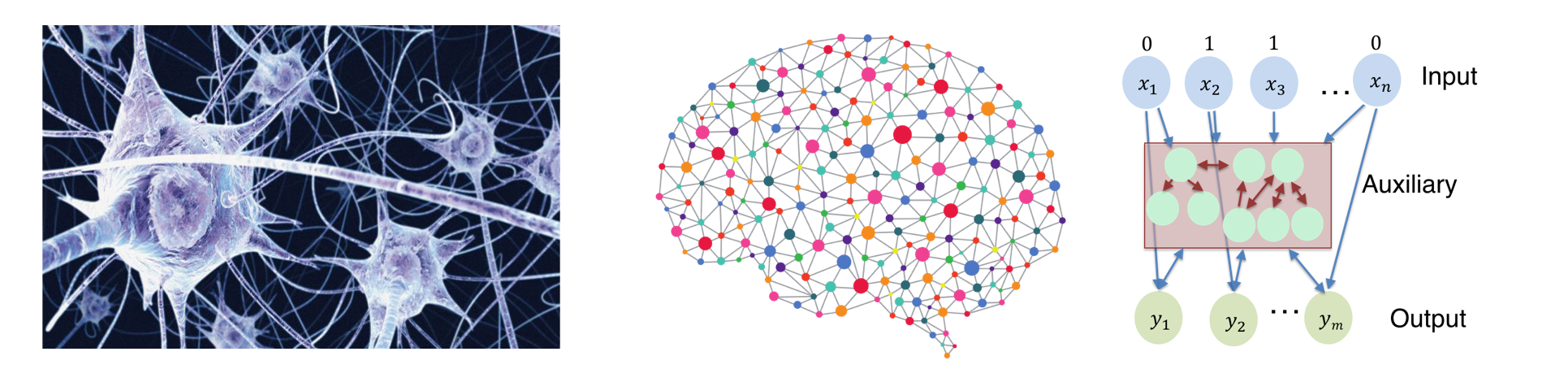
This reading group will cover recent papers in the research area of Brain Algorithms. This area studies specific brain mechanisms for important brain tasks such as memory and recall, focus and attention, decision-making, intuitive and symbolic thinking, and prediction. This involves representing complex concepts in terms of patterns of neural firing, and using those representations to make decisions or produce other types of output. The area studies these mechanisms by modeling them formally as abstract distributed algorithms, and analyzing them using methods from analysis of algorithms.
Topics of interest this term may include recognition of hierarchically structured concepts, novelty detection, and neural assemblies. We will also study some mechanisms that are involve in interaction with the real world. Thus, we will consider representing notions such as position and motion, and using the representations to perform tasks such as orientation and navigation.
We will also consider general issues involved in modeling brain mechanisms, such as composition, abstraction, and general learning rules.
(Tentative) Schedule
(2/7) Overview of our works on SNN and planning: Nancy Lynch
- Brain algorithms overview
- Slides
- Nancy Lynch, Cameron Musco, and Merav Parter. Winner-Take-All Computation in Spiking Neural Networks. arXiv:1904.12591, April 2019.
- Nancy Lynch and Frederik Mallmann-Trenn. Learning Hierarchically Structured Concepts. Neural Networks, 143:798-817, November 2021
- Nancy Lynch and Cameron Musco. A Basic Compositional Model for Spiking Neural Networks. In Nils Jansen, Marielle Stoelinga, Petra van den Bos, editors, A Journey from Process Algebra via Timed Automata to Model Learning: Essays Dedicated to Frits Vaandrager on the Occasion of His 60th Birthday, September 2022, volume 13560 of Lecture Notes in Computer Science, Springer, 2022.
(2/14) Navlakha's work: Brabeeba Wang
- Slides
- A neural algorithm for a fundamental computing problem. S Dasgupta, CF Stevens, S Navlakha. Science, 2017
- Habituation as a neural algorithm for online odor discrimination. Y Shen, S Dasgupta, S Navlakha. Proceedings of the National Academy of Sciences, 2020.
- A neural data structure for novelty detection. S Dasgupta, TC Sheehan, CF Stevens, S Navlakha. Proceedings of the National Academy of Sciences, 2018
(2/21) Papadimitiou and Vempala's work: Sabrina Drammis
- Slides
- Brain computation by assemblies of neurons. Christos H. Papadimitriou, Santosh S. Vempala, Daniel Mitropolsky, Michael Collins, and Wolfgang Maass. Proceedings of the National Academy of Sciences, 2020.
- Center-Embedding and Constituency in the Brain and a New Characterization of Context-Free Languages. Daniel Mitropolsky, Adiba Ejaz, Mirah Shi, Mihalis Yannakakis, Christos H. Papadimitriou. 2022.
(2/28) Overview on rate populational models: Keith Murray
- Slides
- Opening the Black Box: Low-dimensional dynamics in high-dimensional recurrent neural networks, Sussillo and Barak. Neural Computation, 2013.
- Context-dependent computation by recurrent dynamics in prefrontal cortex. Valerio Mante, David Sussillo, Krishna V. Shenoy & William T. Newsome. Nature, 2013.
- Theoretical Neuroscience - Chapter 7: Network Models, Dayan and Abbott (optional)
(3/7) Learning successor representation: Brabeeba Wang
- The hippocampus as a predictive map. Kimberly L Stachenfeld, Matthew M Botvinick and Samuel J Gershman. Nature Neuroscience. (20)1643–1653, 2017.
- Neural learning rules for generating flexible predictions and computing the successor representation. C Fang, D Aronov, LF Abbott, E Mackevicius. bioRxiv, 2022.
(3/14) Computing through neural dynamics and geometry: Keith Murray
- Slides
- Flexible multitask computation in recurrent networks utilizes shared dynamical motifs. Laura Driscoll, Krishna Shenoy, David Sussillo. 2022.
- Neural dynamics and geometry for transitive inference. Kenneth Kay, Xue-Xin Wei, Ramin Khajeh, Manuel Beiran, Christopher J. Cueva, Greg Jensen, Vincent P. Ferrera, L.F. Abbott. 2022.
(3/21) Dopamine for causal inference: Sabrina Drammis
(3/28) Spring break
(4/4) Break
(4/11) Break
(4/18) Comparison of different dopamine hypothesis: Sabrina Drammis, Brabeeba Wang
- Slides
- Mesolimbic dopamine release conveys causal associations. Huijeong Jeong, Annie Taylor, Joseph R Floeder, Martin Lohmann, Stefan Mihalas, Brenda Wu, Mingkang Zhou, Dennis A Burke, Vijay Mohan K Namboodiri. Science. 2022.
- A gradual temporal shift of dopamine responses mirrors the progression of temporal difference error in machine learning. Ryunosuke Amo, Sara Matias, Akihiro Yamanaka, Kenji F. Tanaka, Naoshige Uchida and Mitsuko Watabe-Uchida. Nature Neurosience. 2022.
- A Unified Framework for Dopamine Signals across Timescales. HyungGoo R. Kim, Athar N. Malik, John G. Mikhael, Pol Bech, Iku Tsutsui-Kimura, Fangmiao Sun, Yajun Zhang, Yulong Li, Mitsuko Watabe-Uchida, Samuel J. Gershman, and Naoshige Uchida. Cell. 2020.
(4/25) Learning and computing at the same time: Brabeeba Wang
- Slides
- Continual learning in a multi-layer network of an electric fish
- A Biophysical Basis for Learning and Transmitting Sensory Predictions
(5/2) Connectome based theory in Drosophila: Brabeeba Wang
- Slides
- The Neuroanatomical Ultrastructure and Function of a Biological Ring Attractor. Daniel B. Turner-Evans, Kristopher T. Jensen, Saba Ali, Tyler Paterson, Arlo Sheridan, Robert P. Ray, Tanya Wolff, J. Scott Lauritzen, Gerald M. Rubin, Davi D. Bock, Vivek Jayaraman. Neuron. 2020.
- Accurate angular integration with only a handful of neurons. Marcella Noorman, Brad K Hulse, Vivek Jayaraman, Sandro Romani, Ann M Hermundstad. BioRxiv. 2022.
- Converting an allocentric goal into an egocentric steering signal. Peter Mussells Pires, L.F. Abbott, Gaby Maimon. BioRxiv. 2022.
- Building an allocentric travelling direction signal via vector computation. Cheng Lyu, L. F. Abbott, Gaby Maimon. Nature. 2021.
(5/9) Symbolic and intuitive structures: Nancy Lynch
(5/16) From recurrent networks to neuronal circuits: Keith Murray
- Latent circuit inference from heterogeneous neural responses during cognitive tasks. Christopher Langdon, Tatiana A. Engel. 2022.
- Reverse-engineering recurrent neural network solutions to a hierarchical inference task for mice. Rylan Schaeffer, Mikail Khona, Leenoy Meshulam, Brain Laboratory International, Ila Fiete. NIPS. 2020.